
Ask any math teacher, and they’ll tell you: learning how to add and subtract fractions with unlike denominators is a major conceptual leap for students. How can you help them make that jump effectively? This guide will offer you tips on how to teach in a way that builds real conceptual understanding—the kind that lasts—not just memorized steps.
Key takeaways
- Students need a conceptual understanding of fractions as lengths and as numbers on a number line before learning to add or subtract fractions.
- Adding fractions with like denominators is the first key step. When students understand 1/4 as a length, 1/4 + 1/4 = 2/4 makes sense, while answers like 2/8 signal a misunderstanding of denominators.
- Equivalent fractions are the next critical idea. Students must see that equivalent fractions (like 1/4 and 2/8) represent the same length and position on the number line, even though they look different.
- With this foundation, adding and subtracting fractions with unlike denominators becomes logical, because rewriting fractions as equivalents makes their sizes compatible.
- Visual models, like number lines and area models, prevent common misconceptions and reinforce that fractions are numbers.
- Purposeful practice grounded in visual and numerical reasoning helps students connect equivalence and common denominators beyond memorized procedures.
Lay the groundwork with a conceptual understanding of fractions
Before teaching any algorithms, be sure your students have a strong conceptual understanding of fractions. This will ultimately save you time on reteaching and intervention down the line. Help students develop a solid foundation in three key areas before advancing to fraction arithmetic.
1. Fraction magnitude (size or length)
Students need to understand that a fraction represents a single value, not two separate numbers. The numerator and denominator work together to create a single value (length). Visual models, like number lines, help students compare fraction sizes and decide whether their answers make sense when adding and subtracting fractions.
For example, a student who confidently knows what a “fourth” is can picture it as a length, show the fraction on the number line, and avoid confusion when it comes time to add. Frax helps students build an early understanding of fraction magnitude, using visuals as a strong foundation to help them locate and reason with fractions on a number line.
2. The meaning of the denominator
Denominators show how many equal-sized pieces (or parts) make up a whole. When students add fractions, if the 'pieces' are not the same size at first, the goal is to make them compatible.
For example, to add 1/2 and 2/3, students first need to recognize that halves and thirds are not the same size. After realizing this, they can work to create equal-sized pieces. When both fractions are expressed in equal-sized pieces—3/6 and 4/6—the sum becomes 7/6 or 1 1/6. Using a common denominator allows students to see that they are combining pieces of the same size, reframing the process as a logical first step rather than a rule to memorize.
3. Equivalent fractions
Students must see that equivalent fractions make adding and subtracting much smoother. Students should understand what an equivalent fraction is—different fractions that have the same value—and how to create them intentionally. By finding equivalent fractions with a common denominator, students can turn unlike fractions into like fractions.
Interacting with fractions on a number line helps reinforce equivalency. Students see that fraction lengths, or magnitudes, are equal (with the same location on the number line), even when the fractions look different.
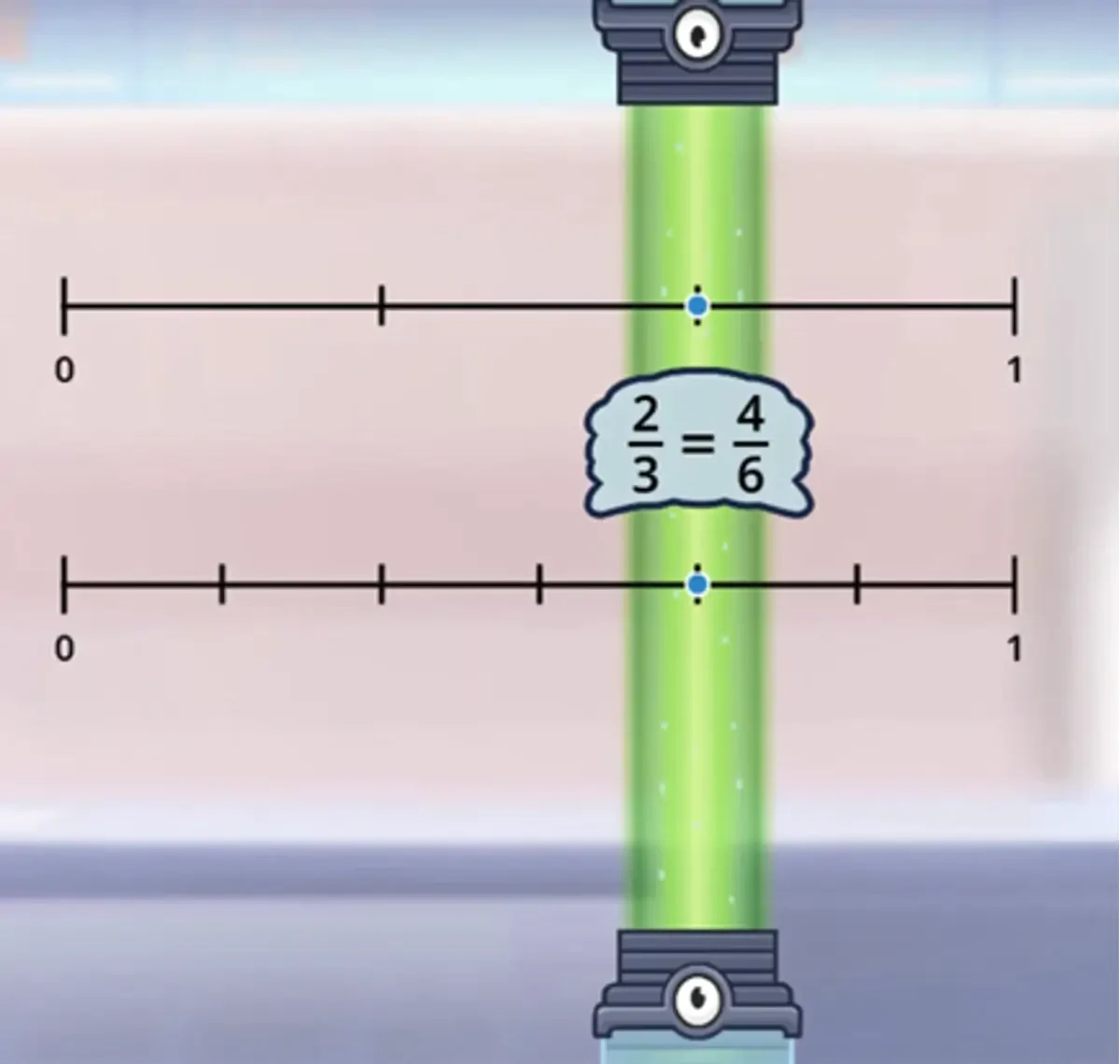
Students develop an understanding of equivalent fractions with Frax.
When these three ideas are solid, students are more likely to succeed with adding and subtracting fractions—and far less likely to rely on guesswork or shortcuts that lead to misconceptions.
Step-by-step guide: How to add and subtract unlike fractions
Here’s a clear, student-friendly process you can model again and again as students subtract or add fractions with different denominators.
- Find a common denominator: Help students think of this as creating equal-sized pieces by finding equivalent fractions. For example, when working through example fraction addition problems like 1/4 + 1/6, students first find a common denominator (12), then rewrite both fractions before adding.
- Create equivalent fractions: Rewrite each fraction so they share the same denominator.
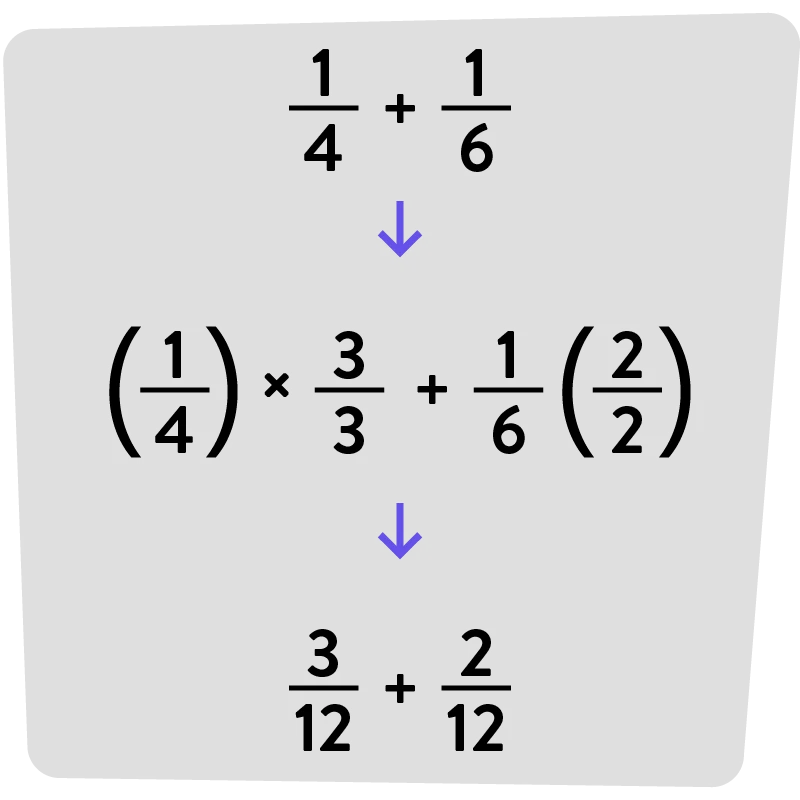
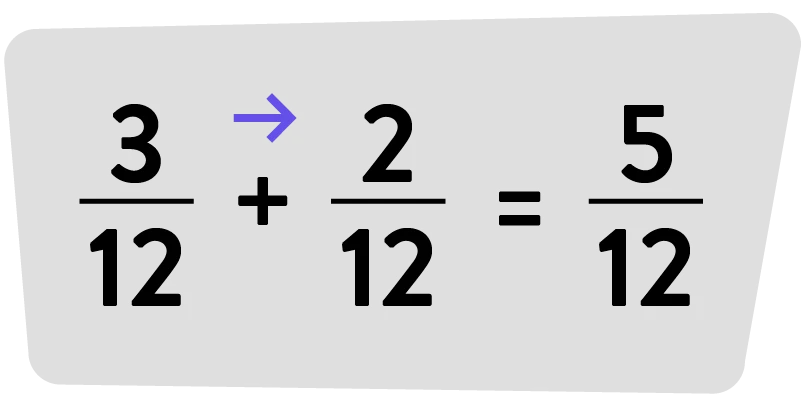
- Add or subtract across with the numerators: Add or subtract the numerators while keeping the denominator the same.
- Simplify if needed: Show students that simplifying fractions connects to what they already know about equivalent fractions.
- Check your work: After solving, students should double-check that the numerator and denominator no longer share any common factors. If they do, they can simplify again.
Practice adding and subtracting fractions with unlike denominators with Frax
Traditional practice problems or fraction addition and subtraction worksheets can only go so far, whereas individualized, adaptive practice can really help learning stick. Tools like Frax support students by allowing them to interact directly with fractions and model their thinking in a game-like environment.
Throughout Frax, students progress through scaffolded instruction, grouped by Sectors aligned with elementary-grade-level fractions standards. Sector 1 lays the foundation, helping students understand fractions as numbers, while Sector 2 expands students’ knowledge of fraction equivalency and early fraction arithmetic.
Sector 3 takes learning further, allowing students to build on their foundations to develop a strong mastery of fraction arithmetic, including creating equivalent fractions, finding common denominators, and adding and subtracting fractions with different denominators.
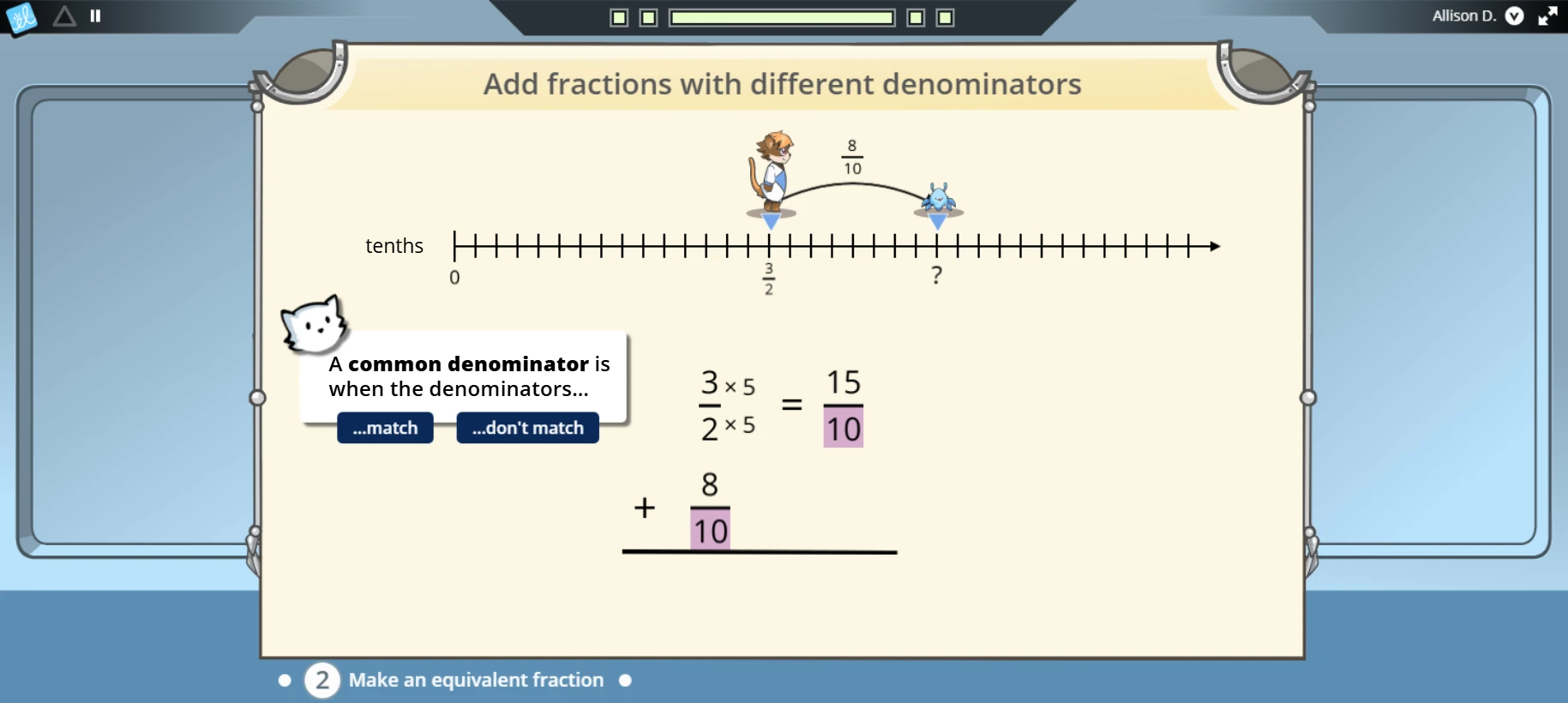
How Frax gradually and purposefully builds understanding
Frax meets students where they are with adaptive, individualized practice. As students progress from Sectors 1–3, they move from concrete visuals to more abstract representations. This gradual shift helps students become confident in tackling advanced tasks, such as how to add and subtract fractions with unlike denominators, independently.
“Sectors 1 and 2 focused hard on how to use a number line,” said Jesse Mercer, Senior Product Designer. “Students have been comparing these unlike fractions since Sector 1. Now in Sector 3, they're adding them. It's this incremental step. It's a hard one for all kids, but it's not a leap anymore. It's a step because they've gone through Sector 1. They did Sector 2, where we introduced that fractions can be added just like normal numbers. We made it really intuitive on the number line again.”
Try Frax in your classroom
If you’re looking for a way to strengthen fraction instruction and reduce student frustration, Frax is a powerful addition to your toolkit. It supports everything from early fraction concepts to fraction arithmetic, all while reinforcing visual understanding and mathematical reasoning.
By combining strong conceptual instruction and purposeful, individualized practice, Frax can help your students truly understand how to add and subtract unlike fractions with confidence.