
Overview: Research on Frax and fraction learning
Fractions are one of the most persistent challenges in upper elementary math, and research shows that if early difficulties don’t resolve on their own, they compound. Studies by Siegler and Pyke found that students’ understanding of fraction magnitudes strongly predicts later fraction arithmetic and overall math achievement, with early misconceptions becoming long-term barriers to algebra and STEM learning.
Targeted fractions instruction matters. A recent study examined how Frax, a research-based fraction learning program, supports below-grade-level learners. All students in the study began below grade level, making the research a true test of Frax as a fraction intervention for academically at-risk learners. This article summarizes the key findings and links to the comprehensive research study for those who want a deeper look at the methodology and results.
About the study
The study evaluated how completing more of Frax’s scaffolded fractions instruction impacted student outcomes. The ExploreLearning research team focused on growth, grade-level attainment, and the impact of deeper engagement with Frax.
Researchers compared outcomes of students who completed Sector 1 and Sector 2 of Frax. Throughout Frax, students progress through missions grouped across three sectors that align with elementary-grade-level fractions standards. Frax missions are structured as game-based, story-driven challenges, allowing students to learn by doing as they progress through carefully scaffolded instruction.
In Sector 1, students develop a strong conceptual understanding of fractions as numbers. After completing Sector 1, learners unlock new missions in Sector 2, where they expand their knowledge to fractions equivalency and early fractions arithmetic. Now available, new Sector 3 will allow students to use the foundations built in Sectors 1 and 2 to navigate new worlds and develop a strong mastery of grade 5 fraction arithmetic.
Study design and methodology
The research followed the grade 2 and 3 student group in a large, suburban U.S. school district over multiple school years (fall 2023–spring 2025). To ensure rigorous and credible comparisons, researchers used 1:1 statistical matching, establishing strong baseline equivalence between groups.
Student outcomes were compared across three usage levels:
- Students with no or low Frax usage
- Students who completed Frax Sector 1
- Students who completed Frax Sector 2
Students’ math achievement was measured using the i-Ready Diagnostic assessments, a widely used and validated benchmark of math proficiency. Researchers analyzed assessment results for students at the beginning of the school year in fall 2023, when students were in grades 2 and 3, and in the spring of 2025, when those same students were completing grades 4 and 5.
Student population
The study took place in a large, diverse suburban U.S. district where more than half of the students were classified as economically disadvantaged. All participating students entered the study below grade-level expectations in math, with the research centered on academically at-risk learners.
This setting positions Frax as a targeted upper elementary math intervention tool rather than solely a supplemental enrichment resource.
Key findings from the Frax research study
Overall, the results show a clear relationship between students who used Frax and improved math outcomes, with stronger results as students progressed further in Frax.
Finding 1: Frax use improves math achievement
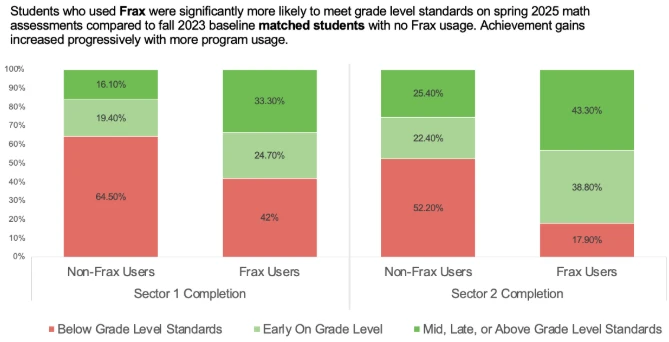
Even though all students began below grade level at pre-test, students who completed Frax Sectors were significantly more likely to reach grade-level proficiency in math on post-tests compared to baseline-matched peers. Students who completed Frax Sectors 1 and 2 showed even greater growth. They were significantly more likely to meet or exceed standards than low/no-use peers (82% vs. 47%), highlighting the added value of progressing into deeper fraction concepts.
Students who completed Frax Sector 1 still showed meaningful improvements in fraction math achievement compared to matched peers with minimal Frax usage. The findings show a clear pattern: increased Frax usage led to stronger outcomes, reinforcing its value as evidence-based math instruction.
Finding 2: Completing Frax Sector 2 leads to greater gains
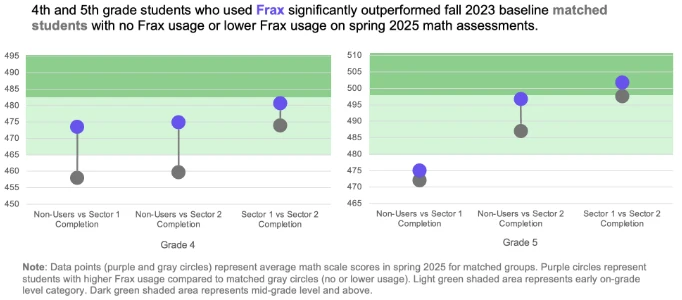
Students who completed Frax Sector 2 significantly outperformed those who stopped after Sector 1.
These impactful leaps in scale scores were strong for students who completed Sector 2, likely due to this Sector's closer alignment with fraction concepts taught in upper elementary grades. By accelerating growth, Frax Sector 2 can also reduce the need for extended remediation, saving instructional time during the school year.
Accelerated growth for older students
Grade 4 students who completed Sector 2 demonstrated a statistically significant average gain of +6.7 points compared to matched grade 4 students who completed Sector 1.
Given the typical i-Ready growth rate of roughly one point per instructional week, the advantage of Frax Sector 2 is equivalent to nearly 7 weeks of additional learning. This finding demonstrates a strong return on investment for schools, both in instructional time and remediation cost-savings, that support continued implementation of Frax beyond Sector 1 into Sectors 2 and 3.
Why deeper Frax engagement matters
These research findings underscore the importance of ensuring students' progress through the full Frax sequence aligned with their grade levels, particularly into Sector 2, where conceptual understanding deepens and achievement gains compound. These improvements not only accelerated students’ readiness for on-grade content but also moved many closer to or beyond the benchmark for Mid, Late, or Above Grade Level placement.
Advancing through all Frax Sectors helps close learning gaps earlier, reducing the need for intensive remediation later on. As an upper elementary math intervention, Frax supports consistent, scalable fractions instruction across grades 3–5, benefiting both teachers in the classroom and districts managing instruction at scale.
Implications for teachers and school leaders
This research points to several clear instructional takeaways:
- Prioritize early and sustained fraction intervention for students below grade level
- Encourage students to progress through all Frax Sectors for maximum benefits
- Use Frax alongside core instruction to strengthen fraction outcomes
- Support consistent routines and implementation to maximize impact
When used intentionally, Frax functions as a powerful complement to daily fractions instruction for lasting long-term outcomes.
Try Frax to support fraction learning
For schools and districts seeking scalable, evidence-based tools to strengthen math foundations, Frax offers a proven solution that helps students overcome persistent barriers to learning fractions, close skill gaps earlier, and build the mathematical readiness needed for long-term success in secondary math and beyond.
Are you ready to experience the Frax difference with your students? Contact us for pilot information, or get started today with a free classroom trial!