
You’ve probably watched multilingual learners get a math concept during hands-on practice, only to later get stuck when the vocabulary gets in the way. It’s obvious that the challenge isn’t a lack of ability, but rather the language load.
Why multilingual learners need targeted math support
Multilingual learners (MLLs) bring strong reasoning skills to your classroom. But unfamiliar terms, abstract concepts, and limited opportunities to use math vocabulary outside of school can hinder students’ ability to demonstrate what they know in math. When language gets in the way, MLLs may disengage, lose confidence, or struggle to understand foundational topics that lay the groundwork for future math, such as fractions.
That’s why targeted strategies for multilingual learners are essential. When you lift language barriers, supporting English language learners in math becomes not only manageable but also transformative to students’ future math success. The right tools can help make math clearer, more accessible, and genuinely empowering for every student.
Frax strategies that make math accessible
Understanding fractions is foundational to math success and a critical stepping stone for higher-level concepts, including algebra, ratios, and proportional reasoning. For MLL students, fractions can quickly become complicated if they don’t firmly understand that fractions are numbers, each with a size and location on the number line.
Frax is an adaptive fractions tool built with all learners in mind, offering support that reduces language barriers so your students can develop a conceptual understanding of fractions in a game-based setting. Discover how Frax helps deliver math instruction that’s clear, scaffolded, and student-centered!
Scaffolded vocabulary introduction
Why trust Frax for multilingual learners? Frax introduces new concepts using plain language first, delaying the introduction of formal fraction terms, such as numerator, equivalence, or common denominator, until students have demonstrated real proficiency with the ideas. By letting students master a skill before naming it, Frax removes unnecessary intimidation and keeps vocabulary learning separate from concept learning.
Explicit vocabulary instruction
Math vocabulary instruction for ELLs requires intentional, explicit instruction with multiple exposures in context rather than isolation. Research by Isabel Beck, Margaret McKeown, and Linda Kucan underscores this point in their book, Bringing Words to Life: Robust Vocabulary Instruction (2013).
Frax uses student-centered vocabulary instruction. Only after students have demonstrated competency with the target skills does Frax introduce the large (and potentially confusing) terms that correspond to them. As students progress through carefully scaffolded Frax missions, they receive multiple opportunities to use vocabulary alongside visual models.
Frax’s math scaffolds for language learners ensure your students feel confident with the ideas before attaching labels—helping them build knowledge that sticks.
“I have several students who do not speak English. They have been working with Frax, and because of that work, they are able to compare fractions. That is not something that I could have done by talking to them. The repetitive problems, scaffolding, and instant feedback have taught them about fractions. Some of these students have limited formal schooling prior to coming to me, so this program has been very good for them to fill in some gaps.”
–Teacher and Math Coach, Massachusetts
Multimodal learning approaches in Frax
You already know that students learn best when they can see, hear, and interact with math concepts. Frax incorporates multimodal learning in math to strengthen understanding and reduce linguistic barriers, giving your MLL learners multiple pathways to access content.
Visual, auditory, and kinesthetic supports
Inside each Frax mission, there are multimodal math scaffolds for language learners to help students learn in ways that make the most sense to them.
Frax includes text-to-speech tools to help reduce decoding challenges, particularly for students who are still developing English proficiency. Interactive visual representations, including length models, number lines, and area models, provide visual and kinesthetic opportunities. Students can select, drag, and drop various virtual manipulatives as they build fraction confidence throughout Frax.
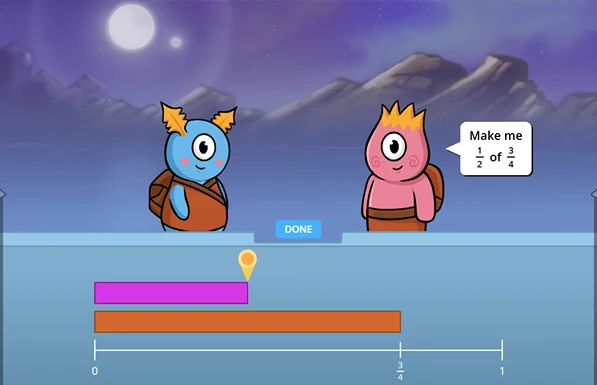
Students interact with visual representations in Frax.
Structured mathematical conversations
Frax also supports meaningful math discourse, something research from Jeff Zwiers highlights as essential for developing academic language. Structured prompts and guiding questions give MLLs a supportive way to practice math language, strengthen reasoning, and build confidence speaking about their ideas.
With Frax’s robust collection of offline activities, you can reinforce key fraction concepts, provide hands-on practice (taking a break from screens!), and provide strategies for multilingual learners that encourage authentic dialogue. Captain's Checkpoints provide additional practice with skills from Frax online missions. These collaborative, discourse-rich activities enable students to discuss fractions, articulate their reasoning during problem-solving, and learn new strategies from their peers. Frax also includes Quick Checks, printable and brief questions that are perfect for exit tickets, task cards, or prompts for math discussions.
Gamification and storylines for engagement
If students feel anxious about math or overwhelmed by a new language, their motivation can drop quickly. Frax is entirely built around galaxy-themed storylines, creating an engaging, low-anxiety environment where MLLs naturally explore fantasy worlds and express themselves through language and emotion.
Aboard the F.F.S. Sable spaceship, students interact with a crew of space ferrets, bots, and other animals in the fractions galaxy. Frax’s characters and storylines support language learners by providing meaningful context for vocabulary and grammar, making abstract language concepts concrete and memorable through narrative structure.

Gamified math learning turns practice into an engaging, play-based experience where curiosity, experimentation, and creativity are rewarded. Frax uses tokens, trophies, and avatar customization to motivate students while providing continuous feedback and requiring them to use new vocabulary in context. This combination fosters intrinsic motivation, encourages consistent participation, and helps multilingual learners build both math skills and language confidence.
Frax results in action
A recent research study measured how Frax supports multilingual learners. Students who used Frax showed greater math growth than their peers with similar starting points who did not use the program.
MLLs and English-proficient students experienced equal gains, suggesting that Frax supports learning across language groups. MLLs who used Frax were also more likely to meet both overall grade-level math standards and fractions-specific benchmarks than their matched peers with no Frax exposure.
Using Frax in dual-language classrooms
Christine Scovill, a fifth-grade dual language teacher in Texas, introduced Frax into her classroom routine four years ago after trying the space-themed learning platform with a math grant. She noticed improvements in students’ fraction knowledge thanks to Frax.
“I brought Frax into my classroom. I work with half native Spanish speakers and half native English speakers. With that population, there are sometimes populations of learners who haven’t had equivalent schooling in their home countries. Using the Frax program has allowed me to build some competencies and their knowledge in working with fractions that wouldn’t have been there otherwise.”
–Christine Scovill, Fifth-Grade Teacher
“I wrote the grant and made sure that it was assigned as licenses to learners in particular, who were second-language speakers learning English, who needed support with fractions because that can be a particularly difficult concept all the way through,” said Scovill. “After having that, I wrote a grant to get the PTO to license Frax for us. And now, beginning this year, I met with my mathematics coordinator for the district three weeks ago, and they're bringing it in for the district.”
Why Frax works for multilingual learners
With vocabulary scaffolds, multimodal supports, structured offline resources, and purposeful gamification, Frax gives you the math scaffolds for language learners to help every student succeed with fractions.
Start your free trial and see how Frax helps every learner succeed.